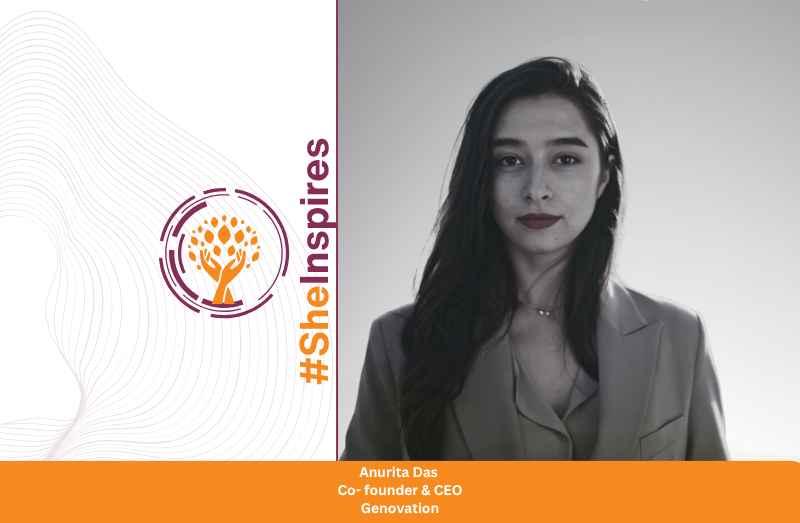
"Safeguarding data is the foundation of ethical AI. Beyond that, bias detection and fairness are equally critical. We at Genovation, use automated systems to identify and mitigate bias using AI itself, creating a self-correcting layer of accountability.
As someone who has co-founded multiple ventures, which leadership qualities have remained constant throughout your entrepreneurial journey?
Two leadership traits that have never changed for me are empathy and clarity. When things become unclear, clarity provides guidance, and empathy helps the team stay focused on the common goal.As time goes on, I’ve also come to understand the value of trust and letting people make their own decisions rather than micromanaging them. At Genovation, we think it’s important to foster an atmosphere where each individual can take the lead. People push boundaries and give their best work when they are trusted with responsibility and purpose. After all, the goal of leadership is to foster belief and ownership, not to exert control.
How do you foster a culture of innovation while ensuring accountability and discipline within your teams?
By allowing people to think freely while maintaining a strong sense of ownership, we promote innovation. Each member of the Genovation team is aware that they are responsible for the results, but they also know they have the freedom to try new things, take risks, and even fail. We support self-leadership over micromanagement.
Our culture is based on openness and trust, and discipline arises from people who are proud of what they do rather than from top-down supervision. Innovation scales sustainably in this way.
With AI adoption accelerating across industries, which sector do you believe is still the most underleveraged for AI-driven transformation?
In my view, construction and agriculture represent two of the most under-leveraged sectors for AI-driven transformation. For example, AI use in construction firms remains extremely low. Some reports show overall adoption as little as 1.5% for smaller firms, even though larger contractors are beginning to explore tools. Similarly, while agriculture is ripe for disruption, only 20-30% of small and medium farms are currently adopting AI solutions.
Beyond those, the public sector also offers vast opportunity. Many government systems hold enormous datasets and complex workflows but face barriers around privacy, trust, and deployment.
With the right privacy-first AI framework, Genovation aims to enable smarter citizen services, risk mitigation, and operational efficiency, unlocking value where it’s still largely untapped.
Genovation specializes in secure, scalable AI solutions. How do you incorporate privacy-by-design principles into your frameworks?
For us, privacy is ingrained in every component of our architecture and is not an afterthought.
Our platform, Mentis, guarantees that all data is encrypted from beginning to end and never leaves the organization’s infrastructure. Additionally, we incorporate bias detection and access controls straight into our models. Organizations can innovate with confidence thanks to this “privacy-by-design” strategy since they know that their data and choices will be transparent and safe.
What are the biggest challenges startups face when trying to balance innovation with compliance in the data privacy space?
Balancing innovation with compliance is one of the hardest parts of building responsible AI. Aligning to global privacy frameworks, from GDPR to SOC 2 and ISO certifications, takes significant time, resources, and continuous monitoring. For startups, this can slow down innovation cycles if not built into the architecture from day one.
At Genovation, we tackle this by embedding privacy-by-design principles directly into our systems. Our models are built so that enterprises retain complete control over their data, ensuring that nothing is shared externally or processed outside their secure environment. This approach allows us to innovate rapidly while maintaining full transparency, auditability, and trust, giving organizations confidence that compliance and creativity can go hand in hand.
As AI increasingly enters sensitive sectors such as healthcare, defence, and finance, how can companies strike the right balance between innovation and ethical responsibility?
At Genovation, we believe that ethics shouldn’t be an afterthought, it should be ingrained into innovation itself. What is considered ethical may evolve with time, but as Albert Schweitzer once said, “The first step in the evolution of ethics is a sense of solidarity with other human beings.”
When it comes to artificial intelligence, that sense of solidarity starts with data, because AI is built on data that originates from human behavior, and human bias inevitably finds its way in.
That’s why safeguarding data is the foundation of ethical AI. Beyond that, bias detection and fairness are equally critical. We use automated systems to identify and mitigate bias using AI itself, creating a self-correcting layer of accountability.
About Anurita Das
Anurita is a seasoned AI entrepreneur with a global career spanning the US, Japan, South Korea, and India. Having contributed to NASA’s CORE Program on artificial intelligence, she has led the development of advanced AI solutions for some of the world’s leading aerospace and automotive companies. She also holds multiple patents and research publications on AI product frameworks, featured on the Microsoft Azure Marketplace, focusing on Generative AI, Explainable and Responsible AI, and Agentic Generative AI.