Close Menu

    Sign Up for updates

    Get the latest news from QUATRO HIVE about law, policy, technology and innovation.

    By signing up, you agree to our terms and privacy policy agreement.

    Trending Now

    Pixels with a Price: Who Owns Your Images in the Age of AI Editing?

    October 29, 2025

    #SheInspires: Anurita Das, Co-Founder and CEO, Genovation Solutions

    October 24, 2025

    RBI issues draft norms to enable banks to fund acquisitions

    October 24, 2025
    Email WhatsApp LinkedIn Instagram Facebook
    LinkedIn Instagram Facebook
    Quatro Hive
    •  LOGIN
    SIGN UP
    • Experts Speak
      • #FinGurus
      • #NextStar
      • #SheInspires
      • #DesiDisruptors
      • #TheSpotlight
    • Dialogues
      • #CyberClout
      • #FinGurus
      • #NextStar
      • #SheInspires
      • #DesiDisruptors
      • #TheSpotlight
    • Directory
      • Tech Solution Providers
      • Universities
    • Resource Library
      • HiveBuzz
      • BuzzQ
      • Bulletin
    • News
      • Industry Updates
      • Media
    • Events & Partnerships
    • Sign Up
    • Login
    Quatro Hive
    Home » Smart Nano-Materials Could Help Detect Explosives With Layers Of Innovation
    Bulletin

    Smart Nano-Materials Could Help Detect Explosives With Layers Of Innovation

    July 22, 2025By QH Editorial Team
    Share
    Facebook Twitter LinkedIn WhatsApp

    A novel sandwich of smart nano-materials could now help detect harmful chemicals including explosives like TNT and RDX even at trace levels.  It holds promise in areas like airport security and environmental pollution monitoring.

    In recent years, numerous methods have emerged to detect harmful chemicals that impact our daily lives. Among them, surface-enhanced Raman spectroscopy (SERS) has stood out for its exceptional sensitivity and reliability. SERS works by amplifying the molecular “fingerprint” signals of chemicals, allowing for precise identification even at extremely low concentrations.

    Noble metals like gold and silver have traditionally been vital for signal enhancement. However, the high cost of gold and the poor long-term stability of silver and remain significant obstacles to their commercial viability.

    Researchers from the Centre for Nano and Soft Matter Sciences (CeNS), Bengaluru, an autonomous institute under the Department of Science and Technology (DST), have developed an innovative multi-layer nanomaterial combining reduced graphene oxide (rGO), silver nanoparticles (Ag) and cerium oxide (CeO₂) on a glass substrate. Each layer contributes a specific function. The team fabricated the composite material using physical vapor deposition techniques, resulting in a uniform and scalable sensing platform.
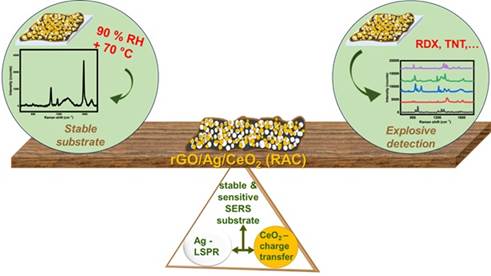
    Fig: The rGO/Ag/CeO2 substrate offers a balanced performance of long-term stability and sensitive explosive detection, driven by the synergistic interplay between Ag-based plasmonic enhancement and CeO2-mediated charge transfer

    While silver nanoparticles are excellent at amplifying Raman signals, they are highly prone to oxidation, especially in humid or warm conditions—reducing their effectiveness over time. The coating of a thin layer of cerium oxide brings two key advantages. It enhances charge transfer between the material and the analyte, further boosting the fingerprint Raman signal of the analyte molecule and also acts as a protective barrier, shielding silver from humidity and temperature-induced degradation and ensuring long-term stability.

    Environmental chamber tests revealed that the substrate maintained its high performance even under extreme conditions—90% humidity and 70 °C—proving its exceptional stability and reliability.

    Meanwhile, the rGO layer plays a crucial role, effectively quenching the overwhelming fluorescence emitted by silver nanoparticles, which would otherwise drown out the distinct Raman fingerprints of the analyte. This clever suppression ensures that the true detection signals shine through with clarity and precision.

    The researchers demonstrated the material’s high performance using 4-mercaptobenzoic acid (MBA) as a model analyte, achieving a detection limit as low as 10 nM. More impressively, the substrate demonstrated the ability to detect a wide range of explosives, including TNT and RDX, at nanomolar concentrations, highlighting its broad potential for trace-level contaminant detection.

    With its excellent sensitivity, durability, and simple fabrication process, this advanced SERS substrate holds strong promise for real-world applications such as airport security and environmental pollution monitoring where detecting chemicals quickly and accurately can make all the difference.

    Know More

    Author

    • QH Editorial Team
      QH Editorial Team

      View all posts
    Resource Library

    Comments are closed.

    Share. Facebook Twitter LinkedIn WhatsApp

    Related Posts

    Bureau of Police Research and Development (BPR&D) concludes CCTV Surveillance Hackathon 2.0 to Strengthen Innovation in Law Enforcement and Digital Forensics

    September 30, 2025By QH Editorial Team

    BSNL’s Indigenous 4G stack embodies Swadeshi spirit

    September 28, 2025By QH Editorial Team

    CSIR-AMPRI designed & developed SODAR system facility inaugurated at IMD

    September 27, 2025By QH Editorial Team
    ads
    Experts Speak

    Pixels with a Price: Who Owns Your Images in the Age of AI Editing?

    October 29, 2025

    India’s Data Centre Policy Landscape : Balancing Incentives with Complexity

    October 27, 2025

    Power Plays: How the SCO Summit Could Transform BRICS’ Energy & Tech Leadership

    October 23, 2025

    From Farm to Fork: Can Agritech Solve India’s ₹1.5 Lakh Crore Food Waste Problem?

    October 15, 2025
    ads
    Stay In Touch
    • Twitch
    • WhatsApp
    • LinkedIn
    • Instagram
    • Facebook

    Quatro Hive is a media and knowledge platform built on four pillars which are law, policy, technology and innovation. In collaboration with key industry players, we are dedicated to cultivating a new era of innovation across industries.

    Address: D-65, Ground Floor, #ZBC-042, Defence Colony, New Delhi – 110024
    Email Us: reach@quatrohive.com
    Contact: +91 11 4121 2828, +91 9311 398 140

    Dribbble WhatsApp LinkedIn Instagram Facebook
    Quick Links
    • Experts Speak
    • Dialogues
    • Directory
    • HiveBuzz
    • BuzzQ
    • Bulletin
    • Industry Updates
    • Media
    • Events & Partnerships
    Newsletter

    Sign Up for updates

    Get the latest news from QUATRO HIVE about law, policy, technology and innovation.

    By signing up, you agree to our terms and privacy policy agreement.

    • Terms and Conditions
    • Privacy Policy
    © 2026 Quatro Hive.

    Type above and press Enter to search. Press Esc to cancel.

    Welcome Back!

    Login below or Register Now.

    Forgot Password?

    Register Now!

    Already registerd? Login.

    Lost your password? Please enter your username or email address. You will receive a link to create a new password via email.