A new highly sensitive, low-cost, point-of-care device with an electrochemical biosensor could help early diagnosis of sepsis at the bedside of the patient.
Sepsis is a serious medical condition caused by an infection that can lead to multiple organ failure, shock and even death. Early and accurate diagnosis is crucial for timely therapeutic intervention and improving patient outcomes, which in turn directly impact mortality rates. Early diagnosis is possible with the precise and sensitive detection of specific biomarkers. Endotoxin, a toxic component of the outer membrane of Gram-negative bacteria, acts as a key biomarker, signalling the presence of an infection that could lead to sepsis.
A group of scientists from the National Institute of Technology Calicut developed eight distinct sensor architectures and a sensitive, low-cost, portable device for detecting endotoxins rapidly and accurately, which in the future can be used at the bedside of the patient.
Seven of them developed by Dr. N. Sandhyarani, Professor, National Institute of Technology Calicut and her team employed electrochemical detection and one utilized optical detection. In all the sensors, appropriately modified nanomaterials such as gold atomic clusters or nanoparticles, CuO, or Cu nanoclusters, MoS2, reduced graphene oxide, or carbon nanotubes were used for enhancing the sensitivity.
In a paper published in the journal Langmuir, the team has demonstrated a highly sensitive electrochemical sensor chip designed for the selective detection of Lipopolysaccharide (LPS), which is compatible with a portable analyzer for on-site detection. The sensor is fabricated using functionalized CNT (fCNT) and copper(I) oxide nanoparticles (Cu2O).
The specific binding of endotoxin to LPS-binding Aptamers or polymyxin B was used to improve selectivity. All the sensors have exhibited high selectivity and detected endotoxin in the presence of other interfering compounds. The presence of endotoxin is also detected in pharmaceutical drug-Biphasic isophane insulin, fruit juices, and whole blood by the standard addition method. Endotoxin recovery was within 2% error in all the cases.
Two of these electrochemical platforms demonstrated versatility by enabling the sensitive detection of Gram-negative bacteria, specifically E. coli, in water samples.
The analysis demonstrates that the quantification of E. coli using these platforms is comparable to traditional biological methods, and also reduces analysis time. This highlights their potential for efficient water quality monitoring.
After creating various electrochemical sensor surfaces, we the team shifted focus to building a point-of-care device. The team has designed, built, and tested a portable and cost-effective electrochemical biosensor prototype specifically for endotoxin detection. This device detects endotoxin in blood serum using a standard addition method, providing results within 10 minutes.
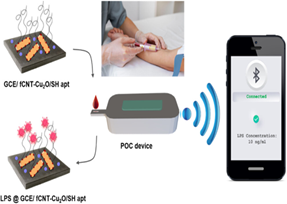
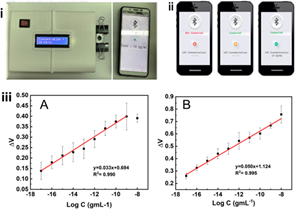
Fig. Schematic diagram showing the sensor chip and working of the device. (i) Photographs of the portable endotoxin detection device, (ii) Operational steps in the Android smartphone user interface for the device, (iii) (A) calibration plot of endotoxin detection with the device in (A) blood samples and (B) grape juice samples. The log (concentration of endotoxin in g mL–1) vs change in voltage received is plotted.
This research, supported by the Nano Mission of the Department of Science and Technology (DST), has resulted in seven publications in reputed international journals such as Biosensors and Bioelectronics, Langmuir (two cover pages), Analyst, and Analytica Chimica Acta and one granted patent for the prototype device.
The researchers are now improving the sensitivity of the prototype device by refining the electronic design to enable a highly sensitive and selective point-of-care (POC) device suitable for rapid, bedside biomarker detection.